



HUMANS OF HEARTS: Dana Ricker
“Soccer gave me a voice, and Hearts gave me the chance to use it.”
Humans of Hearts is a series about members of the Hearts community shaping life in Maine. These voices offer a glimpse into the lives that inspire and connect us across this state we call home.
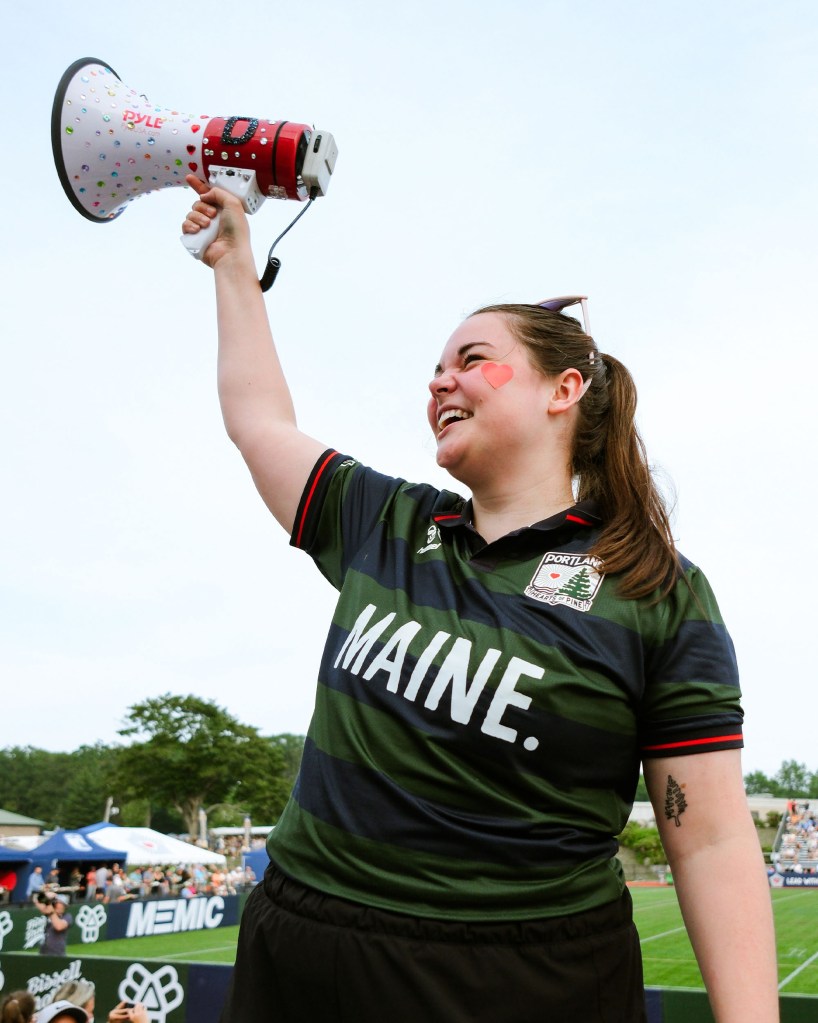
Photograph: Lauryn Hottinger
On matchday in Portland, Maine, the first sound is not the referee’s whistle. It’s a voice. At the front of Section 119, balanced on a fold-out painter’s bench, Dana lifts her bedazzled megaphone. She faces the people, not the pitch, the pine tree tattoo still fresh on her raised arm, her eyes scanning the crowd. A conductor awaiting her orchestra.
“Our home is here!” she shouts.
“Our home is here!” a few hundred voices echo.
“At Fitzy Park!” she calls.
“At Fitzy Park!” they answer.
“So we say up…” she cries. The stadium is alive now, a raucous rhythmic roar on the cusp of crescendo, scarves ready to soar, drums ready to reverberate, itching for their capo’s cue. Into the sparking bullhorn she delivers the final phrase of her most used call and response chant.
She gets her response, the bleachers bounce, and the section affectionately known as The Zoo descends into delirium. For the next ninety minutes, Dana won’t watch the Hearts. She’ll conduct the heartbeat itself.
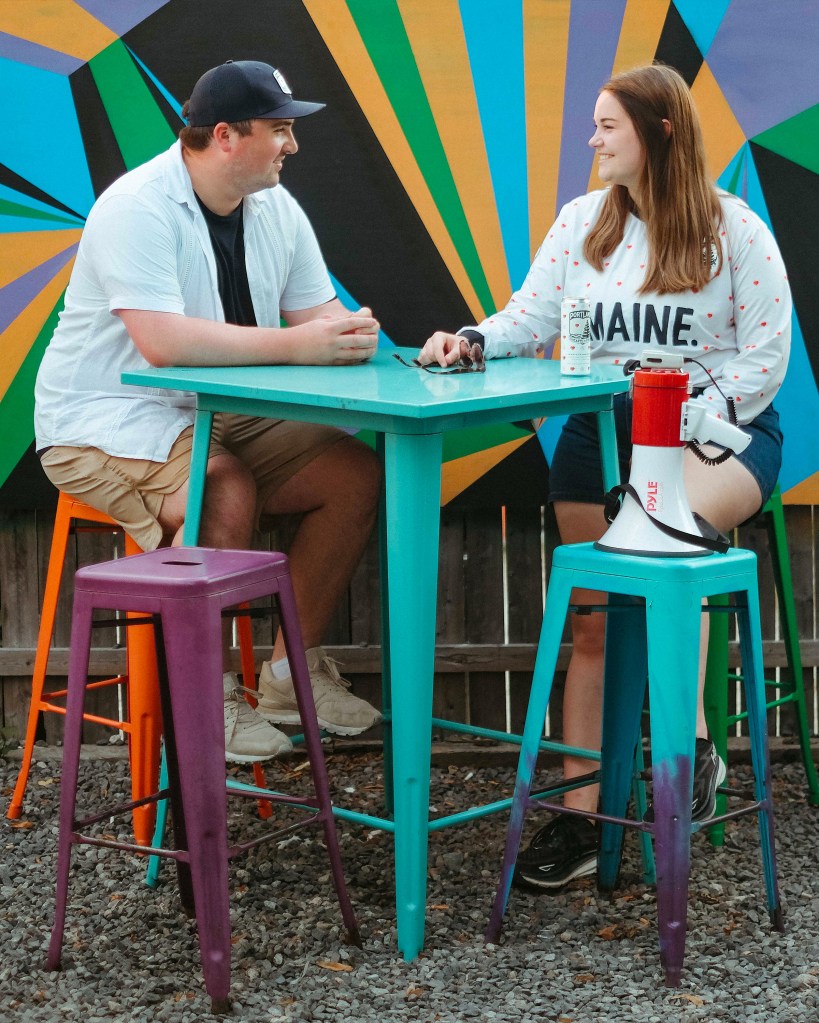
Photograph: Lauryn Hottinger
Known across Fitzpatrick Stadium for her pink bedazzled megaphone and a voice that commands the masses, Dana Ricker serves as the capo—the lead voice of the Dirigo Union on matchdays. In the global game, the capo is both catalyst and compass: part instigator, part maestro, the one charged with turning chaos into chorus. From Dortmund’s Yellow Wall to the Bombanera’s Barras Bravas, capos stand on platforms, often with their backs to the pitch, conducting the faithful in song. Their task is to keep thousands in sync, to transform scattered shouts into a single song. “Your job is to light the spark and never let it go out.”
Dana didn’t grow up with soccer. “I didn’t even know what a Capo was before I was introduced to soccer a few years ago,” she admits.
In her small Minnesota hometown — “I graduated with, like, 56 people in my class, the whole town was maybe 800 people” — soccer wasn’t part of the landscape. The sports in her family were the ones her brothers played. “I didn’t know the stats, I didn’t know the players, I didn’t even understand the lingo. I was always on the sidelines, just watching my brothers.”
Soccer came later. While studying abroad in England, Dana met her future husband Josh. He was already immersed in soccer culture, having made trips to Anfield, Selhurst Park, and St. Mary’s. “Soccer was everywhere—in schools, in the city, jerseys on the backs of kids, grandmas, crossing guards, and on every pub TV, but I remember not really understanding the culture behind it. Like, I didn’t really know what it was and thought, ‘Good for you for going, I’m happy for you,’ but that was not my business.”
That sentiment changed the night Josh brought her to a Minnesota United match.
“I was walking through the stadium, not really noticing anything, moving through a soft gray haze. We edged closer to the supporters’ section. The drumbeats were steady, the chants faint at first, just a murmur beneath the roar of the crowd. And then a voice split through it all, sharp and commanding, carrying over everyone. I tilted my head, followed it, and suddenly everything came into color.
The voice she heard, the capo at the front of Minnesota’s Wonderwall, was the first female capo Dana had encountered. Across supporters and ultras groups in Europe, South America, even MLS, female capos are a rarity in what is usually a male dominated context.“There she was—at the front of the stands, megaphone in hand, moving, singing, chanting, dancing. The crowd bent around her, leaning into every word, every motion. I stood there while everything else disappeared—the game, the lights, the noise outside our section. All that existed was her and the rhythm she had woven through the stands. I didn’t just watch, I absorbed. She was alive in a way that made the whole stadium move with her. And in that moment, I knew: I have to be her. For me, for every woman.”
When Dana and Josh moved to Maine in 2022, Dana was once again struck by how deeply soccer is woven into daily life. “It was everywhere. Completely different from what I’d grown up with. It felt accessible in almost every community.”
Before long, they plugged into the Dirigo Union. When Josh joined the board, Dana found herself at the meetings too, and soon enough she was tossing around chant ideas with other board members. “I’m just such an opinionated person, I can’t stand by and hear people saying, I wonder what we should do, and not give my two cents,” she laughs. “If I think I have a good idea, I’m probably gonna share it.”
When the group needed someone to step up as capo, Dana volunteered. “To think there might be a little girl looking up at me the way I looked up at the capo in Minnesota… it makes me want to cry.”
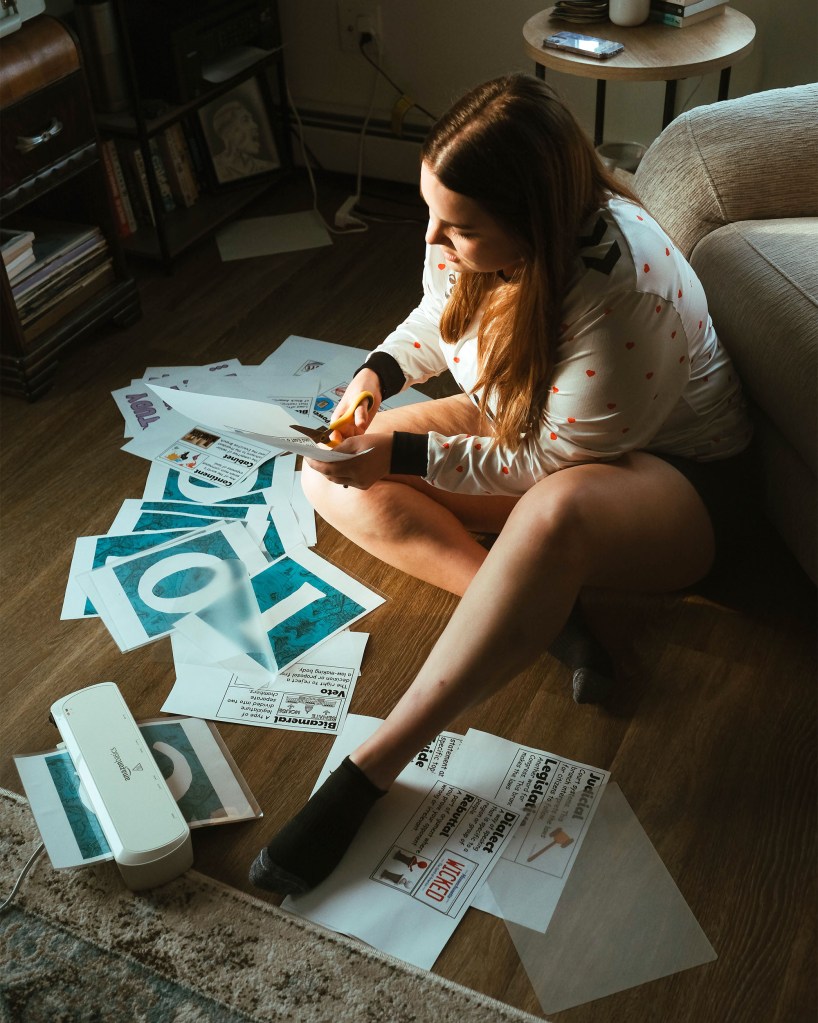
By day, Dana is a middle school teacher. Her seventh-graders at Gorham Middle know her as Mrs. Ricker, though some have stumbled across videos of her at Hearts matches. “They can’t believe it,” she laughed. “To them, I’m just their history teacher. Then they see me on a bench with a megaphone leading thousands of people—it blows their minds.”
While her teaching volume level may be toned down and her vocabulary less colorful, Dana’s work as an educator and a capo run parallel. The same sense of community she finds around Maine’s soccer scene is exactly what she hopes to cultivate in the classroom.
“I know what it’s like when someone feels they don’t fit in. I felt it growing up in a small town. You couldn’t pay me to go back to middle school,” she laughed, “I don’t think you could pay anyone!”
“That’s exactly what motivates me. I want to be the teacher—and the person behind the teacher—that I needed at certain moments growing up.”
Photograph: Lauryn Hottinger
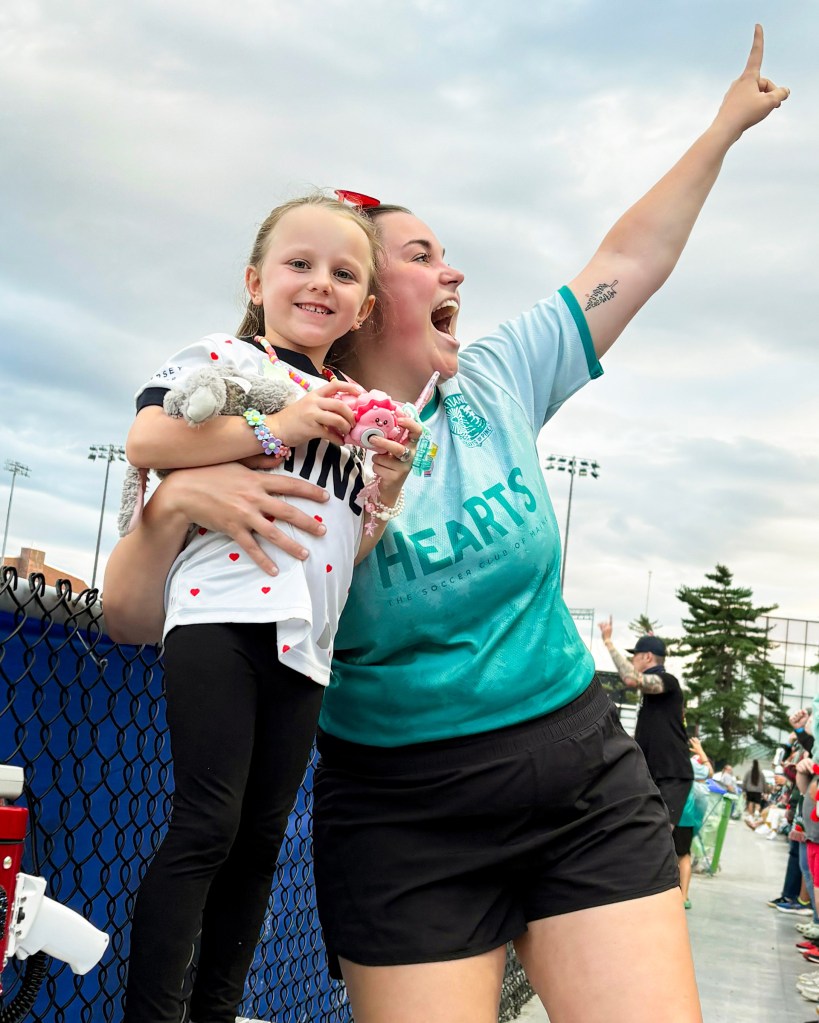
Dana was stepping down from her bench as the halftime whistle went at a recent match when two young girls approached her. She thought they might recognize her from school. But they didn’t. One of them pointed to her bedazzled megaphone. “I like your megaphone.”
The three of them started talking. They told Dana they were at the game with their dads. Dana asked if they liked soccer. The girls responded, “We just like being here and watching you.”
The girls—Emily and Victoria—giggled, hugged Dana, and ran off together. Dana was shaking and glanced over to her husband, Josh who stood nearby, a big smile across his face. “There are countless moments like that,” Dana said.
“As I was packing up after a match one night, a group of girls walked by and thanked me. Later, as I headed back to my car, I saw them again, and suddenly I found myself running to catch up with them. One girl opened her arms and ran toward me. I had no idea who she was, what any of their names were, but we ended up in a huge group hug and they all just kept thanking me.”
She remembers what it was like to stand on the sidelines growing up, an outsider looking in, and how being part of Hearts, and soccer itself, has completely reframed that feeling. “You already have a common ground. Be the reason someone else feels they can step in, the reason they can feel welcome,” she said.
Ask anyone who’s stood in proximity to section 119 and they’ll tell you; when Dana gets on the mic, you’ve not only given permission to join in, you’re going to have a hard time resisting. For women and girls especially, Dana’s influence is nothing short of inspiring.
“The support that lives in the Hearts community is what women should feel like every day walking out their front door. None of us are strangers.That sense of belonging doesn’t need to be earned. It should be offered freely, waiting for anyone who shows up.”
For Dana, Hearts represent something bigger than ninety minutes. It’s the invisible thread between strangers. The sense of belonging. “I spotted an older woman in the grocery store wearing a Hearts sweatshirt. We didn’t know each other, but our eyes met, we shared a smile and a quick high five—just like that, a simple human connection. That’s Hearts of Pine in a blink,” she said.
The same energy she finds in her day-to-day life ripples through the crowd ten fold, gathering momentum, folding everyone together. “When I climb up on my drywall bench in the bleachers and look out at all those faces in the crowd, it feels like I can do anything. There are thousands of people behind me, every step of the way. And it’d be the same for anyone else in my position. That’s the way it should be,” Dana explained.
Dana recalled a phrase she once heard from Hearts’ founder Gabe Hoffman-Johnson. “If you want to be a part of it, you already are.”
“That stuck with me,” she said. “You don’t need to know the game inside and out. You don’t need to prove you belong. You just show up, and you do.”
“People may feel nervous about being outsiders, but the opposite is true here. Just by showing up, by being yourself, you already belong. There’s a spot for you in the stands here, your seat is waiting for you…Just don’t be surprised if you never sit down to use it.”

Photograph: Lauryn Hottinger
Do you know someone connected to soccer who’s making a difference in the Maine community?
We’d love to hear about them! With their permission, send us their name, contact information, and a few words about the impact they’re making. Drop us a note below.
Contact us here at info@heartsofpine.com attn: Christina Ferragamo, Humans of Hearts.